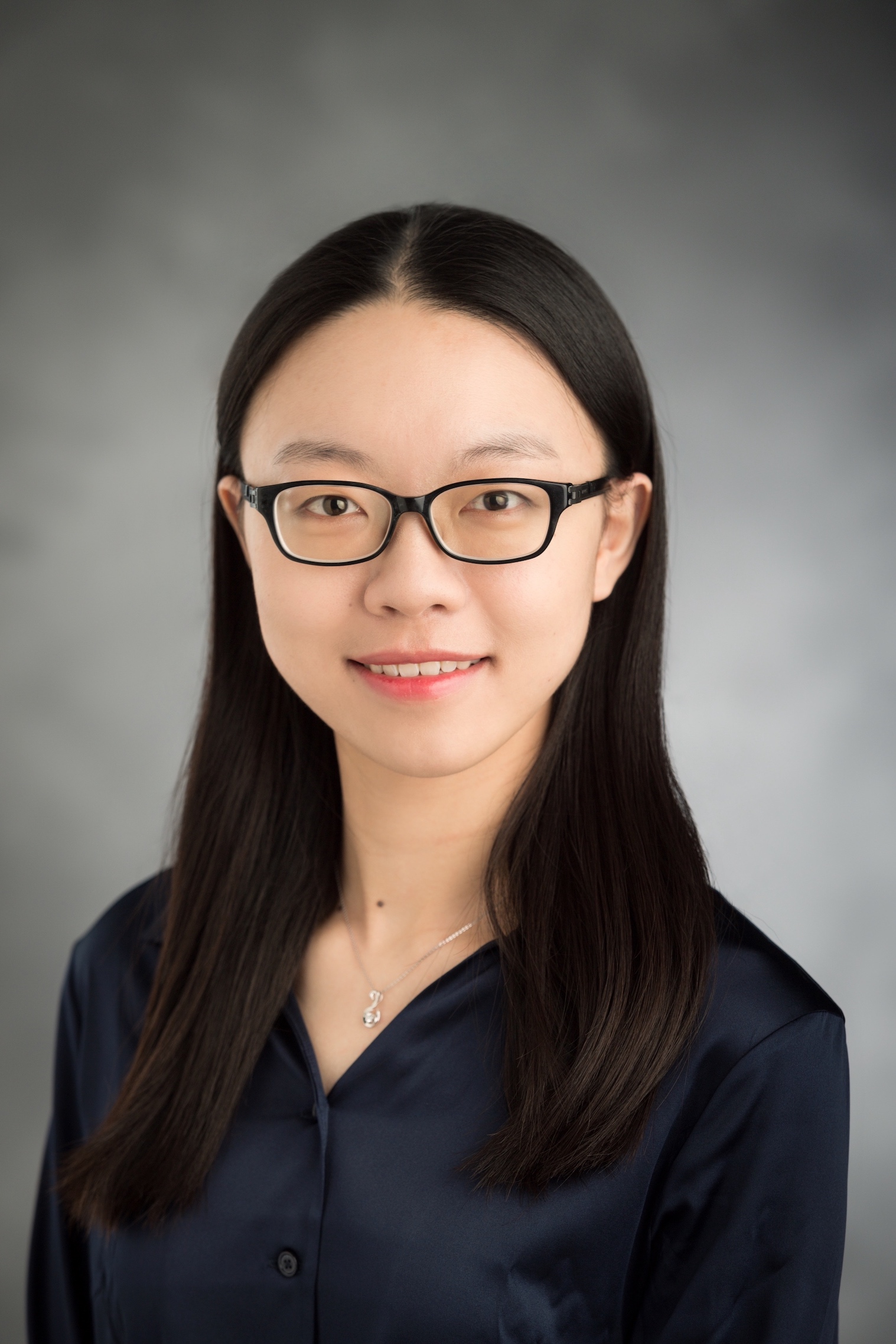
Yuqi Gu
Email: yuqi.gu@columbia.edu.
Address: Room 928 SSW, 1255 Amsterdam Avenue, New York, NY 10027
I am an Assistant Professor in the Department of Statistics at Columbia University. I am also a member of the Data Science Institute.
Before joining Columbia in 2021, I spent a year as a postdoc at Duke University, mentored by David B. Dunson.
In 2020 I received a Ph.D. in Statistics from the University of Michigan, advised by Gongjun Xu.
In 2015 I received a B.S. in Mathematics from Tsinghua University.
My first name can be pronounced as /ju:-tʃi:/. My name in Chinese is 顾雨琦.
My research develops statistical theory and methods for uncovering latent structure in modern complex data. A unifying theme is to make latent structure and representation learning identifiable, interpretable, computationally scalable, and statistically reliable.
- Identifiable deep generative models and causal representation learning: I study identifiability, latent architecture and graph discovery, and causal representation learning in deep generative and nonlinear latent-variable models, with a particular interest in when learned representations admit meaningful statistical or causal interpretation.
- High-dimensional statistical inference for latent structure: The high dimensionality and latent structure pose double statistical challenges. I develop spectral, tensor, and likelihood-based methods for mixture, mixed-membership, and nonlinear low-rank representation problems, with finite-sample theory and uncertainty quantification.
- Statistical measurement and evaluation of LLMs and AI systems: Building on my earlier work in psychometrics and educational assessment, I develop latent-variable and statistical frameworks for measuring, comparing, and interpreting complex AI systems beyond aggregate benchmark scores. Current work studies latent capabilities, semantic task structure, reasoning behavior, and auxiliary representations when evaluating large language models.
Workshop 2026: I am organizing the Workshop on Statistical Foundations of Latent Structure and Representation Learning at Columbia University on November 4–5, 2026. View workshop details.
Representative Publications (see full list)
Underlined are student or postdoc authors under my supervision. ✉ indicates I am the corresponding author.